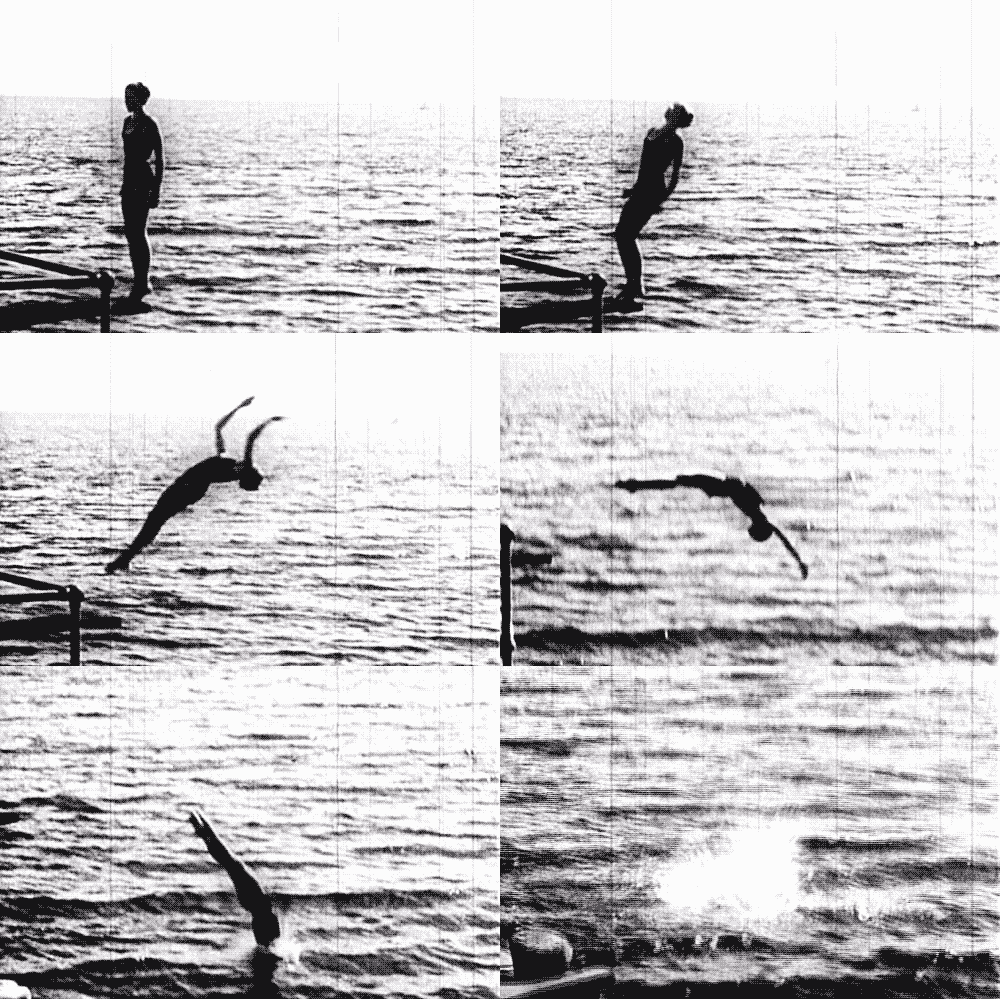
Wednesday, 25 June 2014
Tuesday, 24 June 2014
Monday, 23 June 2014
"...Patricia White just got back from a hip replacement, which she insists came from her long ago days as a dancer, and not from yoga. On Wednesday mornings, she steps into the room on a cane, a striking image in a yoga studio. Who do we put at the front of the room? An older woman walking on a cane. In her class I am beginning to feel tiny openings in the hip flexors and around the collarbones that I’ve never felt before. I can follow this network of fissures and they lead me to new places where I can say yes. It’s like the life you share with your best friends. As they tell you the story of the past weekend, even though the circumstances are new so much of the telling is familiar, you’ve been hearing variations on this story for thirty years. Those small variations are at the heart of what friendship is. How to love these small differences? What Patricia is teaching me is how to get in touch with and love the small changes...."
permission
“Suffering must be like love — look at that guy!”
The man on the cross leads me to wonder about the front of the room. Who do we put at the front of the room? Is it the one with all the muscles, the very smartest, the one with the smoothest pitch? Yoga teachers are embodied ideals. The British psychoanalyst Adam Phillips reminds us that ideals in our culture are often used to punish ourselves. “I’ll never be that smart. I’ll never be that flexible. I’ll never be able to speak those beautiful sentences.” Most of the time, that very traditional view of ideals has been at play in the asana classes I’ve been to. Though there are exceptions. For instance: Christi-an Slomka’s work at Kula Annex. She’s doing something different at the front of the room that allows me to do something different on my mat. She’s modeling her uncertainty and mistakes. It’s become important for her to project those less-than-perfect qualities. Her decision to put something short of ideal at the front of the room is a political decision. “Wait, wait, is that my teacher expressing doubt, inability, even failure? Wow. That gives me permission to fail. That makes my failings ok.” Instead of only giving me permission to succeed, which is just another form of punishment. Because what if you don’t succeed? Oh, then you can play those old self-punishment tapes again, the ones that never sit on the shelf long enough to collect dust.
Only showing our strongest, shiniest face at the front of the room, at the front of a yoga room for instance, seems directly related to over-striving and injury. When I’m given permission to stop practicing right at the edge of my abilities, to stop pushing to the max every instant, to take child’s pose because that supports the whole group, it means that I can respond to patterns of sensation in a new way. I don’t have to push away or push through the pain. I can make a space for softness and inability, and say yes to that. I think this leads to greater embodiment and less injury, but I’m only speaking for myself."
-- Mike Hoolboom from Matthew Remski's ongoing WAWADIA project.
Keep track of this discussion, it's incredibly valuable, thought provoking, interesting stuff!
The man on the cross leads me to wonder about the front of the room. Who do we put at the front of the room? Is it the one with all the muscles, the very smartest, the one with the smoothest pitch? Yoga teachers are embodied ideals. The British psychoanalyst Adam Phillips reminds us that ideals in our culture are often used to punish ourselves. “I’ll never be that smart. I’ll never be that flexible. I’ll never be able to speak those beautiful sentences.” Most of the time, that very traditional view of ideals has been at play in the asana classes I’ve been to. Though there are exceptions. For instance: Christi-an Slomka’s work at Kula Annex. She’s doing something different at the front of the room that allows me to do something different on my mat. She’s modeling her uncertainty and mistakes. It’s become important for her to project those less-than-perfect qualities. Her decision to put something short of ideal at the front of the room is a political decision. “Wait, wait, is that my teacher expressing doubt, inability, even failure? Wow. That gives me permission to fail. That makes my failings ok.” Instead of only giving me permission to succeed, which is just another form of punishment. Because what if you don’t succeed? Oh, then you can play those old self-punishment tapes again, the ones that never sit on the shelf long enough to collect dust.
Only showing our strongest, shiniest face at the front of the room, at the front of a yoga room for instance, seems directly related to over-striving and injury. When I’m given permission to stop practicing right at the edge of my abilities, to stop pushing to the max every instant, to take child’s pose because that supports the whole group, it means that I can respond to patterns of sensation in a new way. I don’t have to push away or push through the pain. I can make a space for softness and inability, and say yes to that. I think this leads to greater embodiment and less injury, but I’m only speaking for myself."
-- Mike Hoolboom from Matthew Remski's ongoing WAWADIA project.
Keep track of this discussion, it's incredibly valuable, thought provoking, interesting stuff!
Sunday, 22 June 2014
Saturday, 21 June 2014
Saturday Poem
One final fall of sun slips past the ridge
behind my shoulder, coats the upper limbs
of a creek-side sycamore in gold too rich
for February, then settles on a stream
dead still, the clumps of foam scattered across
the water hung like fruit on mirrored trees.
The light seems somehow brighter brought to rest,
entangled in the far bank’s canopy—
the earthbound branches leafless, mottled gray
and silver-white, the rough bark’s loosening curls
inverted in immaculate relief,
and shimmering at my fingertips, so close
I have to reach for it, the twice-bent gleam
that passes in the swirl my reaching makes.
—Bob Watts. Art: Renaud Auguste-Dormeuil.
Friday, 20 June 2014
"I think of why I left swimming, left Toronto, left Canada.
I know there are two sides, two lives, feel them acutely, not athlete and adult, but the life of the body and the life of the heart.
I think about loving swimming the way you love somebody. How a kiss happens, gravitational. About compromise, sacrifice and breakup. The heart can suffer more than a few not-quites, have poor timing. We are outtouched by others, can psych ourselves out, we lose, win, become our results, find our place and rank."
-- Leanne Shapton, Swimming Studies
I know there are two sides, two lives, feel them acutely, not athlete and adult, but the life of the body and the life of the heart.
I think about loving swimming the way you love somebody. How a kiss happens, gravitational. About compromise, sacrifice and breakup. The heart can suffer more than a few not-quites, have poor timing. We are outtouched by others, can psych ourselves out, we lose, win, become our results, find our place and rank."
-- Leanne Shapton, Swimming Studies
Thursday, 19 June 2014
Images of evening swimmers on the beach in Nice, It was my daily ritual when I lived there.
(by me from forever ago.)
“I love borders. August is the border between summer and autumn; it is the most beautiful month I know.
Twilight is the border between day and night, and the shore is the border between sea and land. The border is longing: when both have fallen in love but still haven't said anything. The border is to be on the way. It is the way that is the most important thing.”
― Tove Jansson
Twilight is the border between day and night, and the shore is the border between sea and land. The border is longing: when both have fallen in love but still haven't said anything. The border is to be on the way. It is the way that is the most important thing.”
― Tove Jansson
the case for crying
"Salty tears have a communicative power beyond words and reason. But what happens when the waterworks are nothing but crocodile tears, caused by exhaustion, frustration or even a stubborn onion?
In Roman times, when their husbands went to sea, sailors’ wives used to keep “tear bottles” to capture their watery woe. When the sailors returned, they could literally measure how much their wives had really missed them: It was a pretty, albeit controlling, idea. But what was to stop the women from filling the jar with the seawater their loves had sailed away on? It’s as salty as tears, and it would certainly withstand a taste test.
People don’t have to be sad to cry. If I’d been a Roman sailor’s wife, it would’ve been an easy deceit: When I’m tired, I can cry enough to fill a whole tear bottle without the slightest tinge of sadness. After all, tears can express the whole gamut of human emotion, and most of them don’t deal with despair: They can represent ecstasy and joy right across the spectrum to fear, frustration, shock, powerlessness, anger and empathy. But it’s exhaustion that brings me to tears."
Read the rest of the essay here
Words by Romy Ash Photograph by Anja Verdugo for Kinfolk.
Pool of Tears 2 (after Lewis Carroll) by Kiki Smith.
Etching, aquatint, and drypoint with watercolor addition.
Labels:
art,
etching,
kiki smith,
pool of tears,
print,
swimming,
tears
“Tears, idle tears, I know not what they mean"
–Alfred Lord Tennyson
Wednesday, 18 June 2014
On dryland
Lessons
What I learned from the sea.
I love to be near it. To hear it, see the way light plays of it. I like standing, swimming, running, floating in it.
It teaches you respect, that you're supposed to be on dry land. being in it is a crazy dare. The sea is in charge.
I love to be near it. To hear it, see the way light plays of it. I like standing, swimming, running, floating in it.
It teaches you respect, that you're supposed to be on dry land. being in it is a crazy dare. The sea is in charge.
Diving Diagrams

Diagrams showing the trajectory of the major dives as performed at the 1912 Olympics in Stockholm. - See more at: The Public Domain Review
Subscribe to:
Posts (Atom)