Pages

Showing posts with label gravity. Show all posts

Monday, 6 March 2017

beauty comes first

"It is evident that a child will learn a piece of music more quickly where there is melody, rather than an exercise in which only technique is required. Therefore beauty comes first.  In the same way, yoga will be accepted by the body when it is done without resistance. The wave along the spine is like the melody in music. When the beautiful flow of extension is in action, this wave (felt along with the magical attraction of gravity) will help the body find the right adjustment in the performance of the various movements."

--Vanda Scaravelli

Wednesday, 23 March 2016

"Movement frames much of our experience on Earth. We are constantly resisting the pull of gravity and making our way around the world to accomplish our tasks, whether that be taking a shower in the morning, training for a marathon or picking up a tired child to tuck them into bed. Our yoga practice challenges us to untangle the complicated strands of unconscious movement and then re-create a new normal, one that is informed by a fresh understanding of how we perceive our own bodies in space."
- Kate Krumsiek for Yoga Dork

Friday, 18 March 2016

gravity

‘Gravity is a part of nature. It holds the world together. We are all linked by it. We are linked to the earth. The earth is linked to the sun. When we are upright, the pull of gravity is from the waist down. You feel a pull. The earth pulls you down. If you are relaxed and if you are attentive with the body, you feel it. You let the body be sucked by the earth and this is gravity. At the same time the upper part becomes light, open, aware, relaxed.’ 

--Vanda Scaravelli

Friday, 28 November 2014

Vestibular

The vestibular system explains the perception of our body in relation to gravity, movement and balance. The vestibular system measures acceleration, g-force, body movements and head position. Examples of the vestibular system in practice include knowing that you are moving when you are in an elevator, knowing whether you are lying down or sat up, and being able to walk along a balance beam.


Friday, 31 October 2014

The Small Dance, The Stand


These notes were taken in February 1977, during ReUnion’s teaching/performing tour of Contact Improvisation on the West Coast. Throughout the tour, the members of the 1977 ReUnion (Nita Little, Lisa Nelson, Steve Paxton, Curt Siddall, Nancy Stark Smith, and David Woodberry) transcribed each others’ classes, as close to verbatim as possible. What follows are sections from several of Steve’s classes. [Contact Quarterly Editors]
The text is to be delivered slowly, with pauses between each sentence. [Steve Paxton]

The Small Dance, The Stand

Relax deep into the cone of the eye socket. Imagine a line that runs between the ears. That’s where the skull rests. Make the motion, very small, for “Yes.” This rocks the skull on the top vertebrae, the atlas. You have to intuit the bones. Like a donut. The sensation around it defines it. Do the motion for “No.” Between these two motions you can determine the length of the vertebrae.

… Ballooning of the lungs. Breathe from the bottom of the lung up to the clavicle. Can you expand the ribs out and up and back easily? Defining the diaphragm in terms of sensation. Bottom of the lung. Two domes of muscle. So with each breath you’re massaging the intestine… What the diaphragm is doing is a signal to the rest of the body. Sky above, earth below…

The head in this work is a limb. It has mass. Mass may be the single most important sensation. The feeling of gravity. Continuing to perceive mass and gravity as you stand. Tension in the muscle masks the sensation of gravity…

You’ve been swimming in gravity since the day you were born. Every cell knows where down is. Easily forgotten. Your mass and the earth’s mass calling to each other…

…Upward force of the bones. Shoulder blades fall down the back, relaxing the intestines into the bowl of the pelvis… In the direction the arms are hanging, without changing that direction, do the smallest stretch you can feel. Can it be smaller. Can you do less. The initiation of the stretch, along the length of bones, in the direction the force is already going. The small dance—you’re relaxing and it’s holding you up. The muscles keeping the weight throughout the skeleton. Shifting weight from leg to leg, interface, taking weight, compression. Stretching along the line of compression. Center of the small dance.

Upright position… spine erect… Feel the bottom of the lung, the diaphragm, feel it massage the organs, down into the bowl of the pelvis, relax your genitals and anus… breathe deeply… exhale slowly… feel the pause at the exhalation… watch for the beginning of the inhalation… This thing, time… full of rush and pause… feel time go by through the breath… don’t initiate the breath… just watch that period… try to catch your mind, the exact moment when the inhalation starts again…

Standing… Relax erect with the weight toward the back half of the knee, put some weight on the balls of the feet… relax the scalp… relax the eyelids… relax behind the eyes… deep into the cone of the eye socket… don’t spend any energy blocking or focusing… let your ideas flow… because certain things mask other things… and it’s better for this right now to have no concentration… feel the play of rush and pause of the small dance that holds you upright when you relax… through simple mass and balance… 60% on the ball of the foot, some to toes, rest back… knees a little relaxed… Let your breath guide your torso, make you symmetrical… let your ribs be open to the ballooning of the lungs… arms fall sideways… Feel the small dance… it’s always there… think of the alignment of the bones, limbs, towards the center of the earth… length of the bone…

…Take your weight over your left leg… what is the difference… in the thigh, in the hip joint… Calling this sensation “compression,” take compression over the right leg, feel the change… compression down the length of the bone… Take your body to neutral… lean forwardcompression in front, stretch in back… back to neutral… lean backwards, stretch in front, compression in back… don’t have compression in the arms, there’s no weight there… lean forward again… feel the difference… relax… neutral… lean back, stretch along the length of your body… neutral… stretch up… let the spine rise through the shoulders… let the head be supported on a line between the ears… make the motion for “Yes,”… rock the head… the atlas… make a stretch connection, a long line of stretch between the ball of the foot and the atlas, between the toes, the ball of the foot up the leg to the spine, to the atlas… You’ve been falling in gravity since the day you were born…

Imagine, but don’t do it, imagine that you are about to take a step forward with your left foot. What is the difference? Back to standing…

Imagine but don’t do it, imagine that you are about to do a step with your left foot. What is the difference? Back to standing…

Imagine but don’t do it, imagine that you are about to take a step with your right foot… your left foot… your right… your left, right, left…… standing.

…Slowly let your body collapse into a squat… release into a voluntary fall. Breathe, squatting with hands on the floor, neck relaxed… see if you can relax in this position… and come up. [end]

Friday, 8 August 2014


Photographs by Garry Winogrand

 1. Houston, Texas, 1977, from Women Are Better Than Men. Not Only Have They Survived, They Do Prevail, 1978–80.
2. Cheerleaders from Women Are Beautiful, Texas, c. 1970-1975.

jump from dreams

Waking up is a parachute jump from dreams.
Free of the suffocating turbulence the traveler
sinks toward the green zone of morning.
Things flare up. From the viewpoint of the quivering lark
he is aware of the huge root systems of the trees,
their swaying underground lamps. But aboveground
there's greenery - a tropical flood of it - with
lifted arms, listening
to the beat of an invisible pump. And he
sinks toward summer, is lowered
in its dazzling crater, down
through the shafts of green damp ages
trembling under the sun's turbine. Then it's checked,
This straight-down journey through the moment, and the wings spread
to the osprey's repose above rushing waters.
The Bronze Age trumpet's
outlawed note
hovers above the bottomless depths.

In the day's first hours consciousness can grasp the world
as the hand grips a sun-warmed stone.
The traveler is standing under the tree. After
the crash through death's turbulence, shall
a great light unfold above his head?

Tomas Tranströmer, translated by Robin Fulton.

landings

(Found here)

Wednesday, 6 August 2014

‘Gravity is a part of nature. It holds the world together. We are all linked by it. We are linked to the earth. The earth is linked to the sun. When we are upright, the pull of gravity is from the waist down. You feel a pull. The earth pulls you down. If you are relaxed and if you are attentive with the body, you feel it. You let the body be sucked by the earth and this is gravity. At the same time the upper part becomes light, open, aware, relaxed.’ 

--Vanda Scaravelli

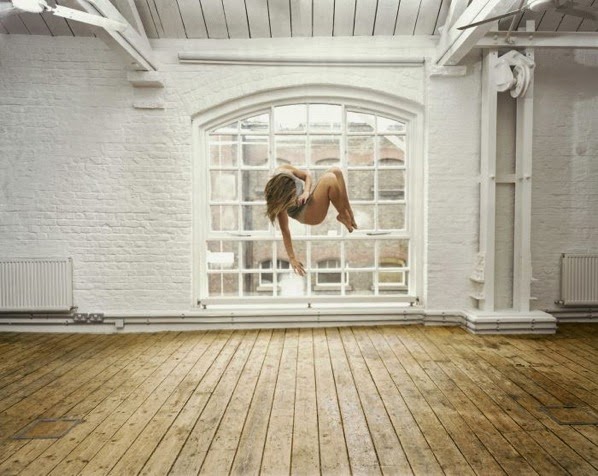
Suspended


Suspended Series by Sam Taylor-Wood

Tuesday, 5 August 2014

talk to her

It has been said (many times) that the most beautiful ballets are the ones that makes us forget the weight of the dancers’ bodies. With Pina Bausch, on the contrary, dance becomes a vehicle of celebration of this weight in its interaction with itself, the others’ and the environment. Her work is used beautifully in Hable con Ella by Pedro Almodóvar with that idea in mind, the dance segments in the film really reflect the musical rhythm and language of the story. I really recommend watching it and if it is of interest this essay is a good read.

Monday, 4 August 2014

shhhhhhh....

 “Sound is the mark of inefficiency.”
Gravity is king! How you move around gravity will define whether you’re an efficient – or inefficient – mover. Remind yourself of the quote above when working on your transitions, jumps and landings. Think of it as moving with a certain self-respect, with grace, elegantly, softly, efficiently – like a cat. The less sound you make, the better.

anti gravity

The Forces With You!


One of the books my Dad wrote with my Aunty way back when.
This was always my favorite,  it explains (to kids) how forces such as gravity, friction, elasticity, and inertia and agents of force such as leverage and balance affect our lives.

The Forces With You, Tom Johnston and Sarah Pooley, 1987

Friday, 11 July 2014

The Many Poses of Marcel Marceau


"Marceau teaches his students to breathe silently when they move. When we watch fish in water, he tells them, it’s beautiful because they’re completely silent. Watching silence is like watching through glass. Silence has a musicality, he says.

On stage, the mime can appear subject to altered physical laws. He can defy gravity. Among the dancers who borrow from Marceau are Rudolf Nureyev and Margot Fonteyn. The dancer and choreographer Roland Petit decrees that all ballet students must train in the art of mime. Zizi Jeanmaire performs mimes with Marceau, dressed in mirror-image white bell-bottoms, a striped top, a squashed hat, and ballet pumps. Michael Jackson is a disciple of Marceau. His moonwalk is a version of “walking against the wind.”"

 Mime acts move like a dream!
Read the rest of the article by Mave Fellowes in The Paris Review.